Thursday, August 26, 2021

Season 41 Draft Grades (NL)


Anaheim Anteaters Grade: C-

                Anaheim had an unmemorable draft. Only notable selection was Ozzie Aspromonte with their first round pick. Aspromonte’s extensive injury history dropped him on many team’s boards even though he grades out to be a setup/CL. Hopefully Anaheim can find some bubble wrap to place this kid in so one day we can see him pitch in the Majors.


Jackson Generals  Grade: A-

                With two first round picks, Jackson selected High School catcher Tony Ortega and College 1st baseman Daryle Adams. Given where Jackson was picking, they made out very well. Ortega has a future behind the plate coupled with a very good bat. Adams may be a below average fielder, but nothing he can’t make up with at the plate.


Scranton Schrutes  Grade: B-

                The Season 40 draft looked as if Scranton threw darts at a dart board hoping one stuck, drafting players with unlikely futures in the ML. Season 41 was a much different story. Drafting 19 yr old CF Dann Blackley and 22 yr old P Larry Street, both look to be nice complementary pieces to a championship roster who will not cost much, but also not kill you with their play. 


Montreal Smoked Heaters Grade: C

               In the second round, Montreal selected Bradley Gore out of Fair Valley High School. Gore had several scholarship offers to schools such as Vanderbilt and University of NC, but elected to join Montreal in hopes of continuing to develop a bat that is already devastating to opposing pitchers.


Chicago Fighting Owls Grade: A

                Chicago took power hitters Glavine and Velazquez in the second and third rounds, and with the second overall pick, they chose R.J Francis out of the University of Alabama. Francis was graded as the best hitting prospect in the draft, who will anchor the middle of Chicago’s lineup for seasons to come. Expect him in the majors sooner rather than later.


Philadelphia Penn Quakers Grade: C+

              Philadelphia had 4 first round picks and used them on two pitchers and two hitters. Livingstone and Crosby grade out to be back of the rotation starts, though Crosby will have to work on his control and ability to get Right handed hitters out. Coste absolutely dominated pitchers at Grand Canyon University…as a DH. The fielding instructor has his hands full with this one. If Coste can’t develop into an adequate first baseman, his time in Philadelphia will be short. All in all, this is the second consecutive draft where Philadelphia has stocked the farm system with essential talent. 


Houston Colt 45's Grade: C

                Houston had 3 picks in top 70 and picked up Darby Levine (2nd Baseman), Willie Harris (P) and Luther Neilson (LF). Darby Levine at 6 is quit a head scratcher, as better options were still available to Houston. Harris and Neilson are nice finds for where they were drafted, and have potential to crack ML rosters at some point. 


Scottsdale Dirtbags Grade: D

                With only compensation picks, Scottsdale drafted Earl Hart and Luther Nixon. Luther Nixon is an above average fielder, but not much else. With a depleted farm system, these picks do little to improve it. 


Las Vegas Desert Dogs Grade: inconclusive

                With their first round pick unsigned, Las Vegas found a nice pick up in the 3rd round with Dutch Gagne. Gagne, another Community College player, fell far on many draft boards. With potential boarder line splits, the power should be enough to propel him into a ML role.


Richmond Brewers Grade: Inconclusive

                It looks as if Richmond decided to punt the draft and dabble in IFA. If Richmond signs his picks, we will circle back. 


New York Empire Grade: B
             With four first round picks, New York went with the even approach drafting two pitchers Seanez and Costilla, and two hitters Bigley and Pimmental. A groundball pitcher, Costilla features a nice first pitcher and control. He has a few good years to continue his development. Pimmental was a nice find in the later round. Exhibits a nice eye and good contact. If Costilla and Pimmental stay off the DL , they will be nice additions to a ML roster. 


Syracuse Syndicate Grade: C

                Syracuse drafted two High School kids with their first two picks. Domingo Franco out of St. Mary’s high school is a well-balanced reliever who dominated his district with a cut fastball. Jim Haynes out of Chico HS lacks the defensive capabilities as a SS, and the bat of a 3rd baseman. Syracuse’s development team will need to make a decision as to where best to develop his under-whelming skills.


Detriot Motors Grade: C-
                 With two first round picks, Detroit selected Henderson Park (RF) and Tex Brantley (SS). As a switch hitter, Park may see better success then a right handed hitter if developed into an every day starter. At minimum, Park will be a nice platoon against lefties. Brantley will have to develop at the plate more to be considered for a ML 3rd baseman job. 


Trenton jakes jokers Grade: 
B

                With only 1 signed pick in the first 10 rounds, Trenton took Mckay Cannon (Rockingham Community College) with the 7th overall pick. Mckay dropped on many teams boards due to his choice of going to community college, But Trenton saw the raw hitting ability of this kids and took a chance. Mckay may grade better as a corner outfielder due to his fielding deficiencies to play the hot corner.


New Orleans Breeze Grade: C+

                New Orleans selected John Cornelius and Morris Carlyle. At pick 15, Cornelius could be considered a steal if he can develop a pitch to pair with his curveball. Morris, a nice contact hitter, may be better suited for CF.


Sacramento Scorpions Grade: C

                Sacramento had 4 first round picks and elected to draft 3-4 year college players which may indicate a retooling rather than a tear it down rebuild. Melker; who was also on the University of Alabama team who won the College World Series championship, may be better suited for a corner outfield position and a bottom of the order slot. Ellenwood has a few development years left to work on his secondary pitch and his VR split to be considered for a low cost, back of the rotation arm. 


Monday, August 23, 2021

Power Rankings 8/23/2021


Commentary 

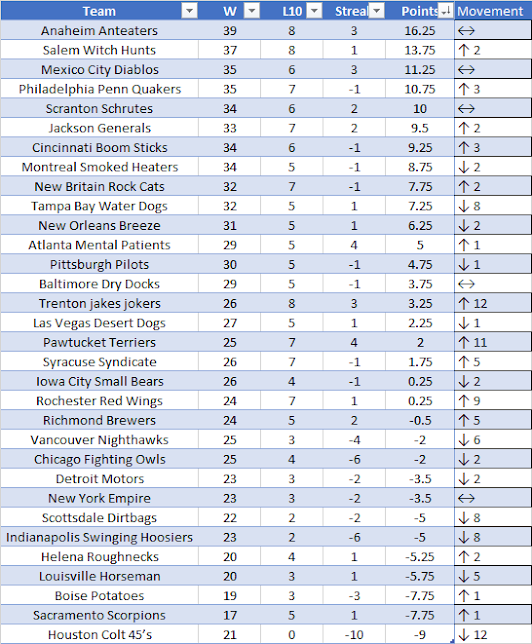
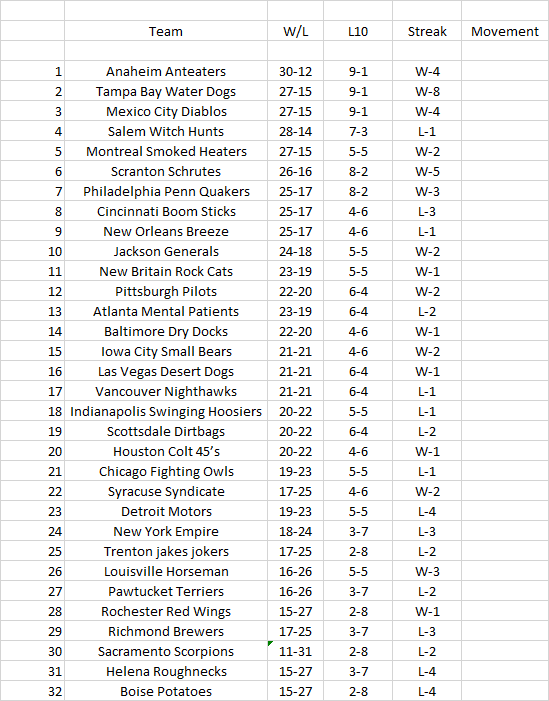
Montreal Smoked Heaters - Inter-League couldn't have come at a better time after getting swept in 3 game series against Philadelphia and Scottsdale, Also lost series against Richmond and Jackson. Montreal bounced back going 10-2 against the AL East. Montreal Averaged 7 runs per game and gave up 4.25 runs per game. A fantastic turn around as they now sit 9 games up on Syracuse. 

Iowa City Small Bears - Iowa moved up 8 spots this week after an abysmal showing (losing 5 of 7) against Rochester. Iowa seems to have found their stride now as they ride a 5 game win streak and on the verge of sweeping number 1 ranked Salem. 

Scottsdale Dirtbags - Scottsdale moves down the rankings 4 spots to occupy 30th. Boasting one of the highest payrolls and one of the oldest teams in the league, One would expect a lineup that is anchored by Eury Flores, Billy Ray Washington and Gene Wagner to produce better results then 28 wins and a bottom 3 NL Offense. As the Trade Deadline approaches, snotpuppies will have to make some tough decisions on the direction of the franchise. 


NL East - What looked to be a two horse race has the potential of being one of the most competitive divisions in the league. 

-Philadelphia and Scranton continue their battle for first in the division, occupying the 6th and 7th spots on the ranking board. 

-Trenton continues its surge up the ranking board 3 more spots as they took 2/3 from Cincinnati, New Orleans, Pawtucket  and on the verge of taking 3/4 from New Orleans. Nothing gets easier for Trenton going forward. They will play Syracuse, Jackson and Montreal. Then back to division play after the All-Star break against Philadelphia and Scranton. 


Monday, August 16, 2021

Power Rankings 8/16/2021


Commentary

Tampa Bay- After an impressive sweep of Baltimore and taking 3 of 4 from Cincinnati, Tampa lost the next 3 of 4 series dropping them 8 spots on the board.  Tampa is now 3 games back of first place in the AL South. 

Trenton -  Trenton saw the biggest positive swing by any team with + 12. After two tough series against Anaheim and Montreal, Trenton was able to get back on track with series wins against 3 sub .500 teams. Trenton has a brutal schedule coming up, They play New Orleans, Cincinnati and New Britain. If Trenton can be competitive during this stretch, Their +12 wasn't an anomaly and they can be considered a viable post season team.  

Pawtucket - Saw the return of All-Star second baseman Albert Candelaria from a broken finger that helped propel them up the rankings board 11 spots by taking 2 of 3 from Tampa and on the verge of sweeping Boise. 

Richmond - After an early season sell off, Richmond is still hanging in there as they move up 5 spots. Richmond's current marathon series with Scottsdale has proved beneficial as they have taken 5 of 6 and have the potential of 6 of 7.  

Houston - nothing rings truer then the saying "Houston, we have a problem". Only boasting 3 wins in the last 16 and scoring 3 or fewer runs in 11 of 16, Houston has fallen to last in the rankings. There is still time for GM Andy to turn things around as we approach the mid point of the season. 

Thursday, August 12, 2021

Wednesday, July 21, 2021

Upper Deck Season 41 Hall of Fame Overview

As we make our decisions regarding Hall of Famers, here is some information about our current Hall of Famers, as well as our current nominees, that may help you fill out your ballot.


A. Current Hall of Famers and Statistics


  1. Position Players


  1. Starting Pitchers


  1. Relief Pitchers


Hall of Fame Composite


  1. Position Players


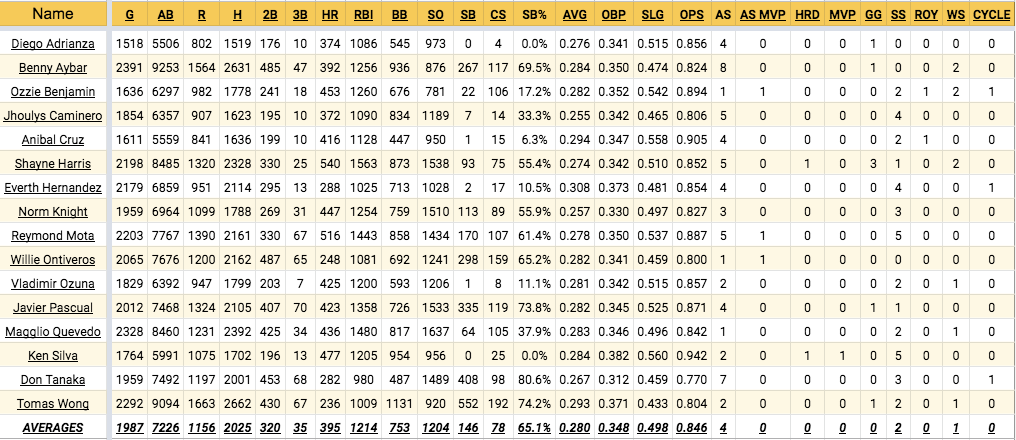
The average Hall of Fame position player was a heart of the order hitter, with 2,447 hits (-48, compared with our last write-up in Season 37, pre-Hall of Fame induction), 395 doubles (-14), 494 home runs (+4), 1,504 RBI (-5) and a 0.887 (-0.003) on base plus slugging (OPS, excluding hit by pitch or sacrifice data).  Additionally, the average Hall of Fame position player made seven All Star appearances, won one MVP, one Gold Glove, four Silver Sluggers, and won one World Series ring (-1).


On a per game basis, the average Hall of Fame position player accrued 1.1 hits in 3.7 at bats, doubled and homered at roughly equivalent rates (0.2 each), scored and batted in 0.7 runs, and walked 0.4 times compared with 0.6 strike outs.


  1. Starting Pitchers


The average Hall of Fame starting pitcher demonstrated excellent control, winning 258 games (-4) and losing 152 (-3), collecting 3,019 strikeouts (-15) against just 1,092 walks (-25), and throwing to a 1.20 WHIP (-0.01) and 3.41 ERA (-0.03).  The average SP made seven All Star appearances, won two Cy Young Awards, one Silver Slugger, and one World Series ring.


On a per game basis, the average Hall of Fame starting pitcher went six innings, allowed 5.5 hits (-0.1), 1.8 walks, and 2.3 earned runs while striking out 4.9.


  1. Relief Pitchers


The average Hall of Fame relief pitcher was a reliable back-end bullpen arm, averaging 508 saves (+41) out of 590 opportunities (+42), converting on 86.1% of chances (+0.9%) in 979 total appearances (-10). He allowed 1.20 baserunners per inning pitched (+0.01) and kept a 3.19 ERA (+0.02). He averaged nine All Star appearances (+1) and two Fireman of the Year awards (-1), but no World Series rings (-1).


On a per game basis, the average Hall of Fame reliever pitched an inning, allowed a hit, 0.4 walks and 0.4 earned runs, and struck out 0.9.


B. Hall of Fame Nominees and Statistics


  1. Position Players


  1. Starting Pitchers


  1. Relief Pitchers


Comparison


Clearly, the averages for all three groups are significantly lower than our current group of Hall of Famers in virtually every category.  However, several players rank as above average, compared with current Hall of Famers, in various categories, including some who would rank in the Top 5 of some categories if elected. Those will be outlined below.


In the meantime, it is important to remember that these are averages: some people fall above, and some people fall below, including current Hall of Famers. Simply falling below the average should not be the sole basis for exclusion. I encourage all owners to look at each player holistically and vote on the merits.


Above Average Position Players

The tables below list each nominated position player and whether or not they were above average in a given category, when compared to current Hall of Famers, on both an absolute and per game basis.


Above Average When Compared with Hall of Famer Statistical Averages


Above Average When Compared with Hall of Famer Award Averages


Above Average When Compared with Hall of Famer Per Game Averages


Above Average Starting Pitchers


The tables below list each nominated starting pitcher and whether or not they were above average in a given category, when compared to current Hall of Famers, on both an absolute and per game basis.


Above Average When Compared with Hall of Famer Statistical Averages


Above Average When Compared with Hall of Famer Award Averages


Above Average When Compared with Hall of Famer Per Game Averages


Above Average Relief Pitchers


The tables below list each nominated relief pitcher and whether or not they were above average in a given category, when compared to current Hall of Famers, on both an absolute and per game basis.


Above Average When Compared with Hall of Famer Statistical Averages


Above Average When Compared with Hall of Famer Award Averages


Above Average When Compared with Hall of Famer Per Game Averages


C. Analysis


Position Players


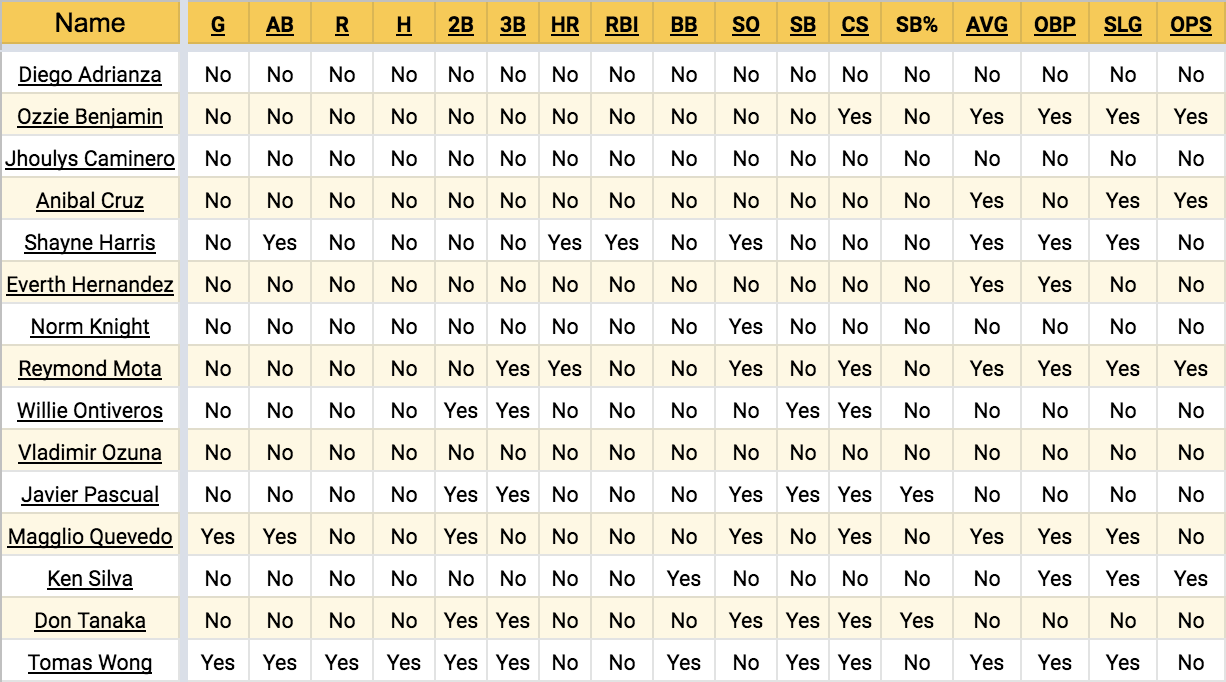
Among nominated position players, Tomas Wong leads the field in terms of categories in which they surpass the Hall of Fame statistical and award averages, with 12. Shayne Harris and Reymond Mota are next with 10 apiece, followed by Ozzie Benjamin with nine.


On a per game basis, Wong leads with 9, followed by Javier Pascual with 8 and Don Tanaka with 7.


Only three nominees average more hits per game than the current Hall of Famers: Benny Aybar, Benjamin, and Wong. Eight averaged more home runs: Diego Adrianza, Benjamin, Anibal Cruz, Harris, Norm Knight, Mota, Vladimir Ozuna, and Ken Silva. Just six average more RBI per game: Adrianza, Benjamin, Cruz, Harris, Pascual, and Silva.


Only Tanaka met the average number of All Star appearances by current Hall of Famers, with seven. Only Silva won an MVP (1). Mota and Silver lead all nominees with Silver Sluggers (five each), followed by Jhoulys Caminero and Everth Hernandez with four.


Starting Pitchers


Among the starting pitchers in this year’s class of nominees, only Glenn Thurman ranks as above average in terms of wins, although three of the five did lose more games than the average Hall of Fame starter (Octavio Castillo, Luis Diaz, and Thurman).  Timothy Hamilton and Bernie megias are the two not to have done so.  Two of the five starters were better than the current Hall of Famers with respect to opponent averages, opponent on-base percentages, opponent slugging percentages, WHIPs, and ERAs: Hamilton and Thurman.


Thurman is the only current nominee to have pitched more innings and have collected more strikeouts than the average Hall of Fame starter. Thurman leads the class with 3,928 punchouts in more than 4,400 IP. He also leads the class in wins with 270. Hamilton, who threw the least IP of the five (3,075.2), is third in strikeouts with 2,840 and is the only candidate with a career ERA under 3.00 (2.98). Hamilton also carries the lowest number of losing decisions (118) and leads the nominees in WHIP (1.13).


In terms of awards, only Thurman exceeded the average number of All Star appearances (7) with nine, followed by five each for Hamilton and Megias. Hamilton is the only nominee to have won multiple Cy Young Awards (2), though Diaz, Megias, and Thurman each won one. Hamilton and Thurman are the only two to have pitched their clubs to World Series titles. Thurman also threw a no-hitter.


On a per game basis, only Hamilton allowed fewer hits, runs, and home runs than those starters already in the Hall of Fame. Only Diaz threw fewer strikeouts per game than the average Hall of Fame starter.


Relief Pitchers


Among relievers, no closer has saved more games than the average Hall of Famer. Conversely, Jose Velazquez spent more time as a set-up man, with more appearances than the average reliever, despite fewer saves and opportunities.


Ezequiel Marrero is the only reliever to have accrued accolades to the same level as current Hall of Famers, with six, though both he and Slim McGowan  made their share of All Star games, attending four apiece. Opponents also fared better against each reliever.


On a per game basis, only Marrero was demonstrably better than those closers already enshrined, allowing fewer hits and walks, and accruing more saves.


D. Hall of Fame Benchmarks


Among hitters, a number of statistical benchmarks appear to be coalescing. I made a determination on these by calculating the number at or above which 75% of current Hall of Famers ended their careers.


The position player benchmarks are as follows:


Statistical Category

Number

Hits

2,222

Doubles

332

Home Runs

421

RBI

1,353

Batting Average

0.280

OPS

0.863

All Star Appearances

5

Silver Sluggers

2


Therefore, one might expect that any position player accruing at least these statistics and winning at least this amount of awards, would have a good shot at being elected to the Hall of Fame.


The benchmarks for starting pitchers are as follows:


Statistical Category

Number

Wins

247

Innings Pitched

3,487

K

3,019

WHIP*

1.26

ERA*

3.69

All Star Appearances

5

Cy Young Awards

0

* These categories were determined using the third quartile, i.e. finding the level at which 75% of Hall of Famers fell at or below over their career.


Therefore, one might expect that any starting pitcher accruing at least these statistics and winning at least this amount of awards, would have a good shot at being elected to the Hall of Fame.


The benchmarks for relief pitchers are as follows:


Statistical Category

Number

Saves

478

Innings Pitched

955

K

811

WHIP*

1.24

ERA*

3.53

All Star Appearances

7

Fireman of the Year Awards

1

* These categories were determined using the third quartile, i.e. finding the level at which 75% of Hall of Famers fell at or below over their career.


Therefore, one might expect that any starting pitcher accruing at least these statistics and winning at least this amount of awards, would have a good shot at being elected to the Hall of Fame.


E. Notes and Lingering Questions


It’s easy for us to think of our Hall of Famers in the context of Major League Baseball: 3,000 hits, 300 wins. The fact of the matter, though, is that longevity in Hardball Dynasty is highly variable, and a career that lasts longer than a solid decade is hard to come by. Despite this, Upper Deck has a long history and we have, through our voting patterns, determined what benchmarks, on average, we deem to be worthy of enshrinement.


Many of the players in this year’s class do happen to fall below Upper Deck’s own historical averages. That said, the way that we vote this year will shift those averages in one direction or another, and just because a player is below those numbers does not mean he is not worthy. 


How long was the player’s peak? How strong was it?


No Hall of Fame pitcher has ever won the Most Valuable Player award. Should a starter who wins the MVP be a shoo-in for enshrinement? Should a reliever who wins the Cy Young be a shoo-in? Could a shut down reliever who never closed games be elected?


Only one Hall of Fame position player has fewer than 2,000 hits. Could another do so? Could we elect a defensive wizard whose offensive statistics pale in comparison to the averages?


There are many questions we have yet to answer, but that we will over time. It is exciting each year to draft talent, to watch those players progress, win awards, and meet milestones, and later to determine if they did enough to make the Hall.


F. Future Directions


In the future, as our Hall of Fame inducts more players, I intend to break things down by position, as Hall of Fame second basemen would look quite different, statistically, from Hall of Fame catchers, for example.  This is complicated by the fact that many players change positions as their skill sets evolve, so I will probably consider players to be a certain position based on time spent at the position (innings played), with some consideration to where their Gold Glove awards were won, if applicable.


Monday, July 13, 2020

Upper Deck Season 37 Hall of Fame Overview


As we make our decisions regarding Hall of Famers, here is some information about our current Hall of Famers, as well as our current nominees, that may help you fill out your ballot.

A. Current Hall of Famers and Statistics

Position Players


Starting Pitchers


Relief Pitchers


Hall of Fame Composite

Position Players

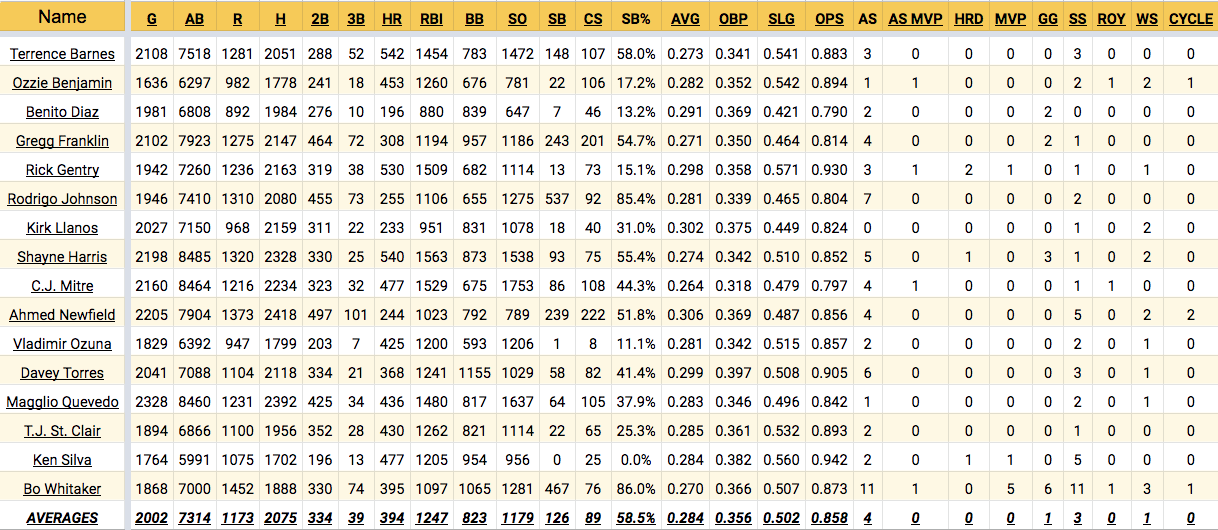
The average Hall of Fame position player was a heart of the order hitter, with 2,495 hits (+18, compared with Season 36, pre-Hall of Fame induction), 409 doubles (+3), 490 home runs (-10), 1,509 RBI (-14) and a 0.890 (-0.007) on base plus slugging (OPS, excluding hit by pitch or sacrifice data). Additionally, the average Hall of Fame position player made seven All Star appearances, won one MVP, one Gold Glove, four Silver Sluggers (-1), and won two World Series rings.

On a per game basis, the average Hall of Fame position player accrued 1.1 hits in 3.7 at bats, doubled and homered at roughly equivalent rates (0.2 each), scored and batted in 0.7 run, and walked 0.4 times compared with 0.5 strike outs.

Starting Pitchers

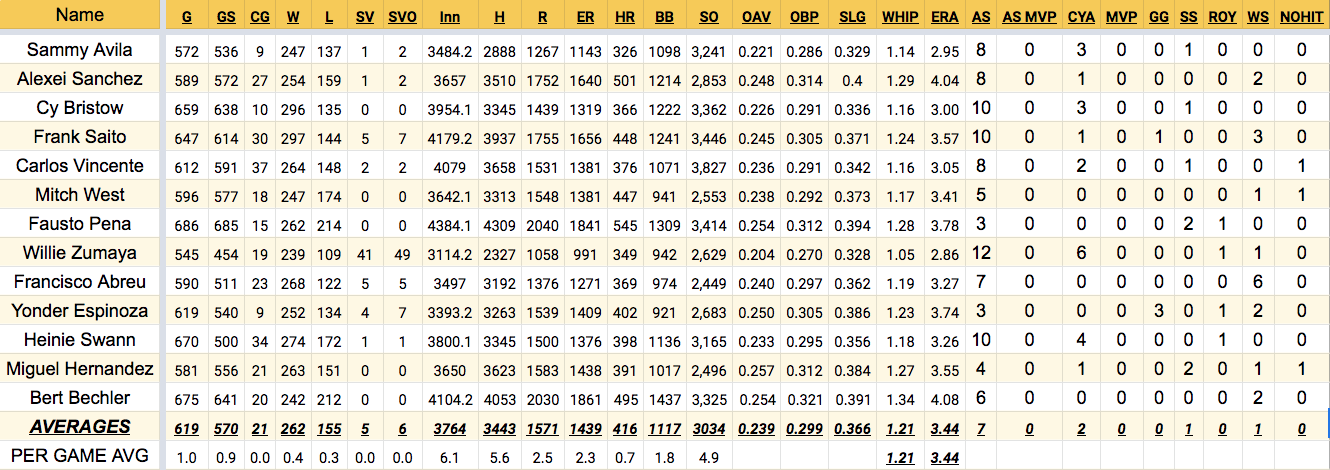
The average Hall of Fame starting pitcher demonstrated excellent control, winning 262 games (-2) and losing 155 (+5), collecting 3,034 strikeouts (+24) against just 1,117 walks (+26), and throwing to a 1.21 WHIP (+0.01) and 3.44 ERA (+0.06). The average SP made seven All Star appearances, won two Cy Young Awards, one Silver Slugger, and one World Series ring.

On a per game basis, the average Hall of Fame starting pitcher went six innings, allowed 5.6 hits (+0.1), 1.8 walks, and 2.3 earned runs while striking out 4.9.

Relief Pitchers

The average Hall of Fame relief pitcher was a reliable back-end bullpen arm, averaging 467 saves out of 548 opportunities (85.2%) in 989 total appearances. He allowed 1.19 baserunners per inning pitched and kept a 3.17 ERA. He averaged eight All Star appearances, three Fireman of the Year awards, and one World Series ring.

On a per game basis, the average Hall of Fame reliever pitched an inning and a third, allowed a hit, 0.4 walks and 0.4 earned runs, and struck out 0.9.


B. Hall of Fame Nominees and Statistics

Position Players


Starting Pitchers



Relief Pitchers


Comparison

Clearly, the averages for all three groups are significantly lower than our current group of Hall of Famers in virtually every category. However, several players rank as above average, compared with current Hall of Famers, in various categories, including some who would rank in the Top 5 of some categories if elected. Those will be outlined below.

In the meantime, it is important to remember that these are averages: some people fall above, and some people fall below, including current Hall of Famers. Simply falling below the average should not be the sole basis for exclusion. I encourage all owners to look at player holistically and vote on the merits.


Above Average Position Players

The tables below list each nominated position player and whether or not they were above average in a given category, when compared to current Hall of Famers, on both an absolute and per game basis.

Above Average When Compared with Hall of Famer Statistical Averages


Above Average When Compared with Hall of Famer Award Averages


Above Average When Compared with Hall of Famer Per Game Averages


Above Average Starting Pitchers

The tables below list each nominated starting pitcher and whether or not they were above average in a given category, when compared to current Hall of Famers, on both an absolute and per game basis.

Above Average When Compared with Hall of Famer Statistical Averages


Above Average When Compared with Hall of Famer Award Averages
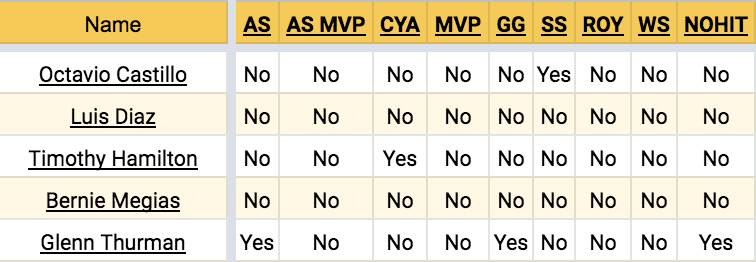


Above Average When Compared with Hall of Famer Per Game Averages


Above Average Relief Pitchers

The tables below list each nominated relief pitcher and whether or not they were above average in a given category, when compared to current Hall of Famers, on both an absolute and per game basis.

Above Average When Compared with Hall of Famer Statistical Averages



Above Average When Compared with Hall of Famer Award Averages


Above Average When Compared with Hall of Famer Per Game Averages



C. Analysis

Position Players

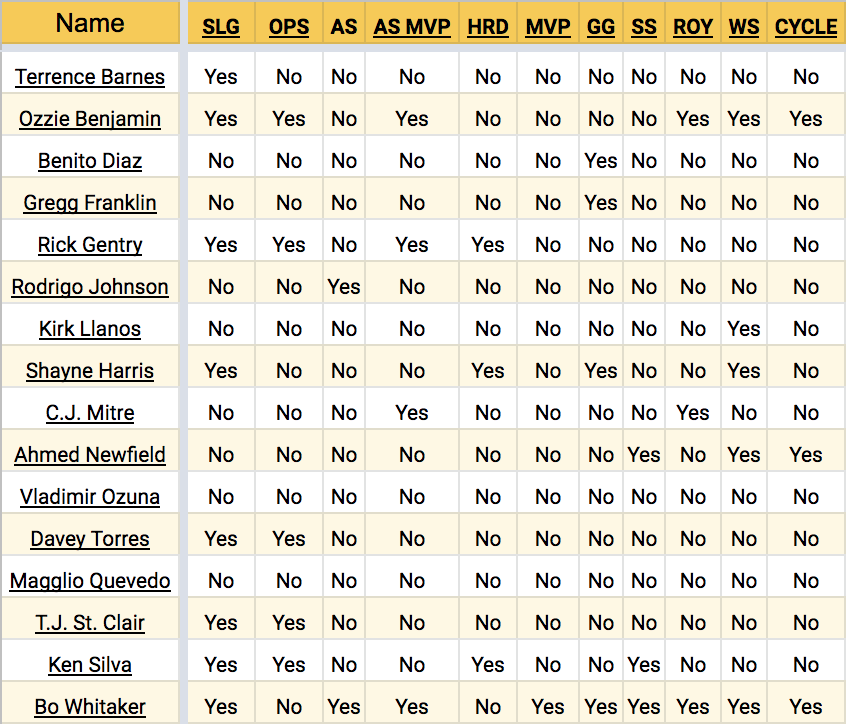
Among nominated position players, Bo Whitaker obliterates the field in terms of categories in which they surpass the Hall of Fame statistical and award averages, with 15. Shayne Harris and Ozzie Benjamin are next with nine a each, followed by Ahmed Newfield with six.

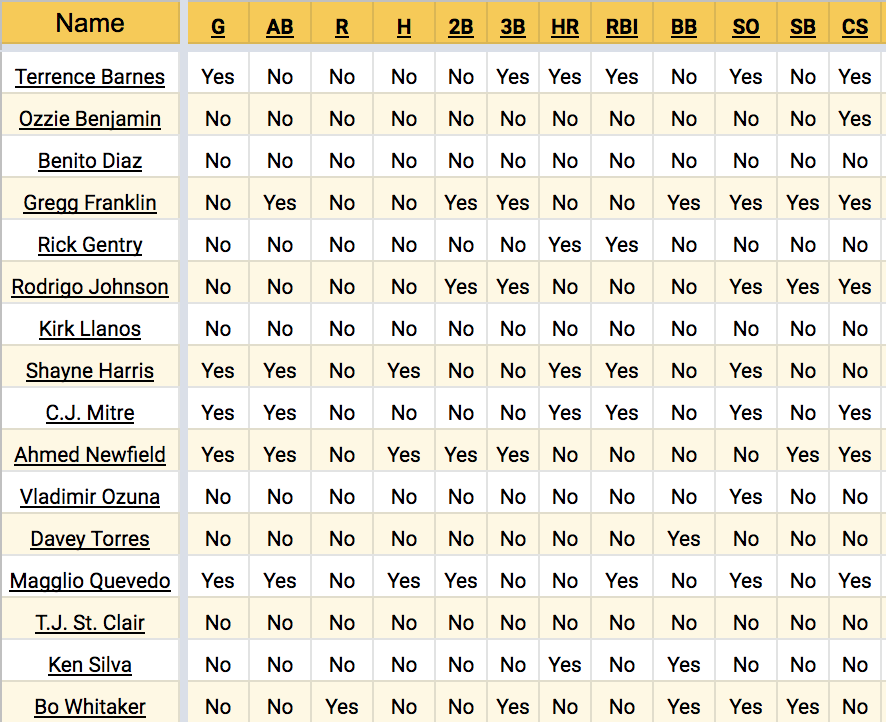
On a per game basis, however, Gregg Franklin, Magglio Quevedo, and Newfield lead with seven, followed by Terrence Barnes, C.J. Mitre, and Harris with six.

Only three nominees average more hits per game than the current Hall of Famers: Harris, Newfield, and Quevedo. Five average more home runs: Rick Gentry, Ken Silva, Barnes, Harris, and Mitre. Just five average more RBI per game: Barnes, Gentry, Harris, Mitre, and Quevedo.

Only Johnson and Whitaker met the average number of All Star appearances by current Hall of Famers, with seven and 11, respectively. Three nominees won at least one MVP, including Gentry (1), Silva (1), and Whitaker (5). Whitaker leads all nominees with Silver Sluggers (11), followed by Newfield and Silva with five.

Starting Pitchers

None of the starting pitchers in this year’s class of nominees rank above average in terms of wins, although three of the four did lose more games than the average Hall of Fame starter. Howie Henry is the only not to have done so. All four starters have worse opponent averages, opponent on base percentages, opponent slugging percentages, WHIPs, and ERAs than the average Hall of Fame starter, as well.

Odalis Mesa is the only current nominee to have pitched more innings than the average Hall of Fame starter, though no nominee threw more strikeouts than the average Hall of Famer. Octavio Castillo leads the class with 2,876 punchouts, despite finishing second to last in terms of innings pitched. He also leads the class in wins with 257.

In terms of awards, none of the starters come particularly close to the average number of All Star appearances (7), though Diaz and Henry come closest with four apiece. Similarly, Diaz and Henry each won one Cy Young Award, falling just short of the average for current Hall of Famers (2). Castillo’s Silver Slugger stands out as the only other category in which a nominee meets the Hall’s award average.

On a per game basis, no starting pitcher was demonstrably better than those currently in the Hall, with the exception of Castillo striking out more hitters, and being more likely to register a win, on a per game basis.

Relief Pitchers

Among relievers, Pedro Ordonez was the only closer to have saved more games than the average Hall of Famer, and at a higher rate (86.3%). Conversely, Albert Jimenez spent more time as a set up man, with more appearances than the average reliever, despite fewer saves and opportunities.

Neither pitcher accrued accolades to the same level as current Hall of Famers, with Ordonez winning the only Fireman of the Year award among the two, though Ordonez and Jimenez both made their share of All Star games, attending six and three, respectively. Opponents also fared better against both closers, although Ordonez successfully limited extra base hits at a better rate than the average Hall of Famer.

On a per game basis, neither pitcher was demonstrably better than those closers already enshrined.


D. Hall of Fame Benchmarks

Among hitters, a number of statistical benchmarks appear to be coalescing. I made a determination on these by calculating the number at or above which 75% of current Hall of Famers ended their careers.

The position player benchmarks are as follows:


Therefore, one might expect that any position player accruing at least these statistics and winning at least this amount of awards, would have a good shot at being elected to the Hall of Fame.

The benchmarks for starting pitchers are as follows:


* These categories were determined using the third quartile, i.e. finding the level at which 75% of Hall of Famers fell at or below over their career.

Therefore, one might expect that any starting pitcher accruing at least these statistics and winning at least this amount of awards, would have a good shot at being elected to the Hall of Fame.

The benchmarks for relief pitchers are as follows:


* These categories were determined using the third quartile, i.e. finding the level at this 75% of Hall of Famers fell at or below over their career.
Therefore, one might expect that any starting pitcher accruing at least these statistics and winning at least this amount of awards, would have a good shot at being elected to the Hall of Fame.


E. Notes and Lingering Questions

It’s easy for us to think of our Hall of Famers in the context of Major League Baseball: 3,000 hits, 300 wins. The fact of the matter, though, is that longevity in Hardball Dynasty is highly variable, and a career that lasts longer than a solid decade is hard to come by. Despite this, Upper Deck has a long history and we have, through our voting patterns, determined what benchmarks, on average, we deem to be worthy of enshrinement.

Many of the players in this year’s class do happen to fall below Upper Deck’s own historical averages. That said, the way that we vote this year will shift those averages in one direction or another, and just because a player is below those numbers does not mean he is not worthy.

How long was the player’s peak? How strong was it?
No Hall of Fame pitcher has ever won the Most Valuable Player award. Should a starter who wins the MVP be a shoo-in for enshrinement? Should a reliever who wins the Cy Young be a shoo-in?
Could a shut down reliever who never closed games be elected?

Only one Hall of Fame position player has fewer than 2,000 hits. Could another do so? Could we elect a defensive wizard whose offensive statistics pale in comparison to the averages?

There are many questions we have yet to answer, but that we will over time. We’re a relatively young world, but it is exciting each year to draft talent, to watch those players progress, win awards, and meet milestones, and later to determine if they did enough to make the Hall.


F. Future Directions

In the future, as our Hall of Fame inducts more players, I intend to break things down by position, as Hall of Fame second basemen would look quite different, statistically, from Hall of Fame catchers, for example. This is complicated by the fact that many players change positions as their skill set evolves, so I will probably consider players to be a certain position based on time spent at the position (innings played), with some consideration to where their Gold Glove awards were won, if applicable.